
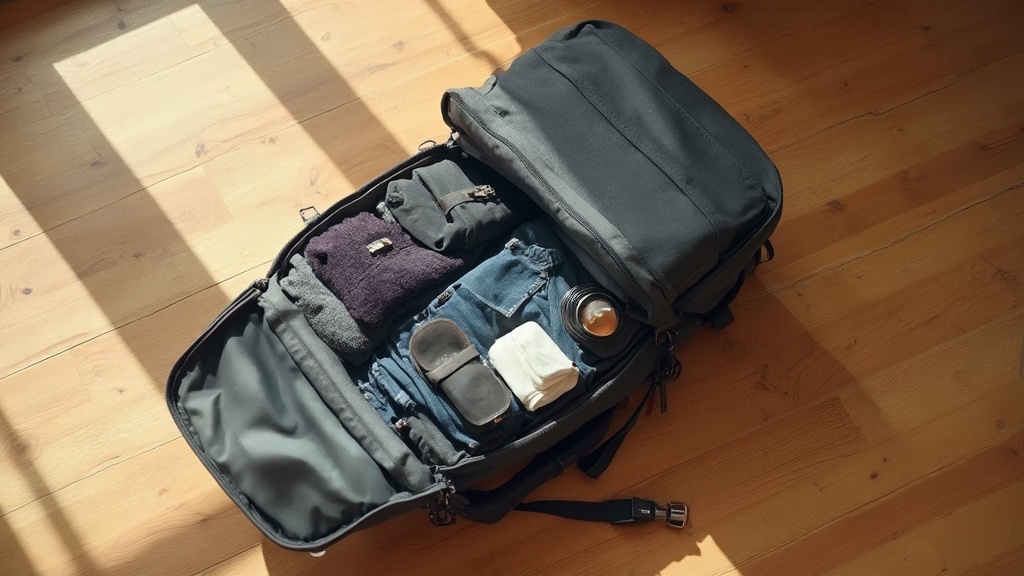
The Ultimate Carry-On Packing List for a 2-Week Europe Trip
There's a specific kind of dread that hits when you're in a Ryanair boarding queue and the overhead-bin sizer is right there, waiting. Your bag is probably fine. But "probably" is doing a lot of work at that moment.
Two weeks in Europe on one carry-on is absolutely doable — we've done it on itineraries ranging from a Barcelona weekend to two full weeks crisscrossing France, Italy, and Croatia. But it requires a slightly different approach than the usual "pack less" advice. Europe adds specific complications: strict low-cost airline size rules that changed again in 2026, cobblestone streets that destroy the wrong shoes, churches that turn you away at the door if you're wearing a tank top, and weather that swings 15 degrees between morning and evening in April.
This carry-on packing list for Europe is the one we actually use — not a philosophical guide to minimalism, but a specific, itemized system tuned for spring and summer travel across cities and countryside alike.
Choose Your Bag Before You Pack
The single most consequential packing decision you'll make is which bag to bring — because European low-cost carriers don't agree on what "carry-on" means, and in 2026 they're actively enforcing it with metal sizer boxes at the gate.
Current overhead bag allowances:
- Ryanair: 55 × 40 × 20 cm, 10 kg (Priority boarding required — budget €10–25 per flight segment)
- EasyJet: 56 × 45 × 25 cm (with EasyJet Plus or certain seats)
- Wizz Air: 55 × 40 × 23 cm, 10 kg (WIZZPRIORITY required)
Show up with an oversized bag and the gate fee is €40–75 — meaningfully more than the Priority add-on you skipped. Ryanair and Wizz have effectively harmonized their dimensions, so a bag that fits one fits the other.
The Osprey Farpoint 40 (and women's Fairview 40) is the most battle-tested option — clamshell opening, harness tucks away flat so it doesn't snag on the sizer, and comfortably within those limits. The Peak Design Travel Backpack 45L is the premium pick: it compresses down for LCC compliance and opens like a suitcase from the front, which we find far better than a top-loader at airport security. Either of those, plus the Priority fee, beats paying for checked luggage every time.
The Clothing Formula: Spring vs. Summer
The biggest packing mistake travelers make is treating all European seasons the same. April in Paris and August in Seville are entirely different problems.
Spring (April–June)
European spring is beautiful, unpredictable, and cold by 6 PM. Temperatures swing 10–15°C within a single day across France, Italy, and Spain. You need to dress for that range without filling your bag.
Tops (4):
- 2 merino wool t-shirts — temperature-regulating and odor-resistant enough for 2–3 wears between washes
- 1 long-sleeve merino or soft cotton shirt (doubles as your evening option when you want to look less "tourist")
- 1 lightweight button-down for warm afternoons and any dress-code situations
Bottoms (3):
- 1 dark jeans or chinos — the workhorse; appropriate for anything from a morning museum to dinner
- 1 casual pants or comfortable joggers in a breathable fabric
- 1 shorts
Layers (2):
- 1 packable waterproof jacket — genuinely non-negotiable in spring; April showers show up everywhere from Lisbon to Prague
- 1 merino cardigan or thin sweater for evenings
Underwear and socks (5 each): Merino or quick-dry synthetic. Darn Tough socks come with a lifetime warranty and hold up through a lot of hand-washing.
Summer (July–August)
Summer changes the equation dramatically. Seville in August hits 37°C. Rome's cobblestones radiate heat at 2 PM. Prioritize lightness over versatility.
Tops (4):
- 3 lightweight tops in linen, cotton gauze, or jersey — jersey resists wrinkles and works well for living out of a bag for two weeks
- 1 slightly nicer linen or cotton shirt for evening restaurants and rooftop bars
Bottoms (2–3):
- 1 linen pants or light chinos
- 1 casual dress, skirt, or shorts
- 1–2 swimsuits if you're doing any beach segments — pack two, because one will always be damp when you want to wear the other
Layers (1):
- 1 lightweight cardigan or linen overshirt for air-conditioned trains, museums, and restaurants (European AC in July is often brutal)
The church hack that works in every season: Keep a lightweight scarf or sarong in your day bag. It weighs nothing, solves the bare-shoulders problem at St. Peter's Basilica, the Sagrada Família, Florence's Duomo, and essentially every cathedral that turns people away at the entrance — and doubles as a beach cover-up, a picnic blanket, or an impromptu blanket on a cold overnight bus. One item, five uses.
Shoes: Two Pairs, but Pick Them Carefully
Two pairs — that's the rule. Any more and you're sacrificing too much space for one of the heaviest categories.
The Europe-specific wrinkle that most carry-on guides gloss over: cobblestones. Not just that they're tiring, but that wet cobblestones in Lisbon's Alfama, Rome's Centro Storico, or Dubrovnik's old town are genuinely slippery. Smooth-soled fashion sneakers — the kind that look great — can send you sliding. The real test for any shoe: hold the sole against your palm and push. If it grips without sliding, it'll work on wet stone.
Pair one — your main walking shoes: Something with a grippy rubber outsole that you could walk 15,000 steps in without suffering. New Balance 2002R, On Cloudstratus, women's Ecco Touch flats with textured soles, or Birkenstocks (which also happen to work on cobblestones). Wear these onto the plane — they're the heaviest item and you don't want them eating bag space.
Pair two — sandals or comfortable slip-ons: For beach towns, evening strolls when you've earned a break, and anywhere you're not covering miles on stone. Flat flip-flops are fine for the shower; anything you're walking in should have some ankle support.
Toiletries, Tech, and Europe-Specific Essentials
Toiletries
Flying budget means your liquids go in a small plastic bag. The cleanest solution is going mostly solid:
- Solid shampoo bar (Lush and Ethique are both widely available in European cities if you run out)
- Travel-size deodorant stick — aerosol counts as a liquid, so skip the spray
- Toothbrush and a small toothpaste
- SPF for your face (under 100ml)
- Prescription medications plus a basic first-aid kit: plasters, pain reliever, antihistamine
Leave the full-size versions at home. Pharmacies are everywhere in Europe, and buying a shampoo locally costs a fraction of a gate-check fee.
Power adapters
Most of continental Europe uses Type C round two-pin plugs at 230V. The UK and Ireland use Type G three-rectangular-pin plugs — a completely different adapter. Check your itinerary before you pack. The good news: most modern devices (phones, laptops, USB chargers) are dual-voltage — look for "100–240V" printed on the adapter brick. If it's there, you need only an adapter, not a converter. Old-school hair tools are the exception; check the label or leave them at home.
SIM card or eSIM
We use Airalo for European data — around $37 for 20GB over 30 days, covers the EU. Holafly offers unlimited data but throttles significantly after roughly 4.5GB of real-world use, so "unlimited" has caveats. Either way: set it up and activate it before you leave home on your home network. Don't try to figure it out at the airport.
Anti-theft day bag
Paris, Barcelona, Rome, and Lisbon all have active pickpocket problems in tourist areas. An anti-slash crossbody worn diagonally across your body — front-facing, not dangling off one shoulder — eliminates most of the risk. Pacsafe's Metrosafe X has stainless steel mesh lining and lockable zippers. It's not cheap. It's also not as expensive as replacing a stolen passport mid-trip.
Drop a small AirTag inside your main bag before you leave. The one time you need it, it earns its keep.
Three Things That Make Carry-On Life Actually Work
Plan one laundry day per week. Budget hostels, most Airbnbs, and plenty of hotels either have a washing machine or point you to the nearest laundromat. €5–10 per load, 45 minutes of your time. This is how you travel two weeks in five tops without smelling like it. Sink-washing works fine for merino — hang it before you sleep, it's dry by morning.
Use packing cubes. Not primarily for compression (they don't compress much), but because moving every 2–3 nights turns a bag without cubes into a pile you dig through. One cube per category — tops, bottoms, tech — and you always know exactly where things are.
Pack to 80%. Leave room on day one. You will buy things — a scarf at a market, ceramics in a town you didn't plan to stop in, the perfect linen shirt from a shop that caught your eye. A maxed-out bag on departure day means paying to ship things home, or walking away from things you'd regret leaving.
Where to Go Next
If you're building an itinerary that relies more on trains than budget flights — which dramatically relaxes the luggage rules and adds scenery — our guide to the most scenic train journeys in Europe is worth reading before you book your route. And if you're keeping costs tight across the whole trip, our breakdown of how to travel Europe on $50 a day gives a realistic city-by-city spending plan for 2026.
For deeper countryside itineraries where you'll really appreciate the light pack — hidden gems in Tuscany beyond Florence covers the slower hill towns that reward travelers who can walk in and walk out without dragging a suitcase over ancient stone.
One bag. Carry-on only. Straight out of the airport while everyone else waits. That's the whole plan.
Related Posts

5 Tips to Save Money on Flights in 2026
Booking windows, alliance hacks, and mistake fare alerts — five updated strategies that are genuinely saving travelers $200–$500 on flights in 2026.

Tokyo Nightlife: From Golden Gai to Shibuya Sky
Your complete Tokyo nightlife guide: from Golden Gai's 200 micro-bars to Kabukicho neon, live music in Shimokitazawa, and rooftop views from Shibuya Sky.

Best Greek Islands to Visit in Shoulder Season
The best Greek islands in shoulder season mean half the crowds, lower prices, and September seas that run warmer than most summer destinations.